Concepts — the mental model
This page is the thread that ties every lab together. Read it once before you start; come back whenever a lab makes you ask "why are we doing this?"
The workshop has one through-line:
Start with a single model call, and end with a grounded, tool-using, evaluated, observable agent — all inside one Foundry project.
Each module adds exactly one new capability to that arc.
1. Everything starts with one client
You authenticate once with DefaultAzureCredential (az login), build an
AIProjectClient from your project endpoint, and ask it for an OpenAI-compatible
client. That single client gives you chat, embeddings, and the Responses API that
powers agents.
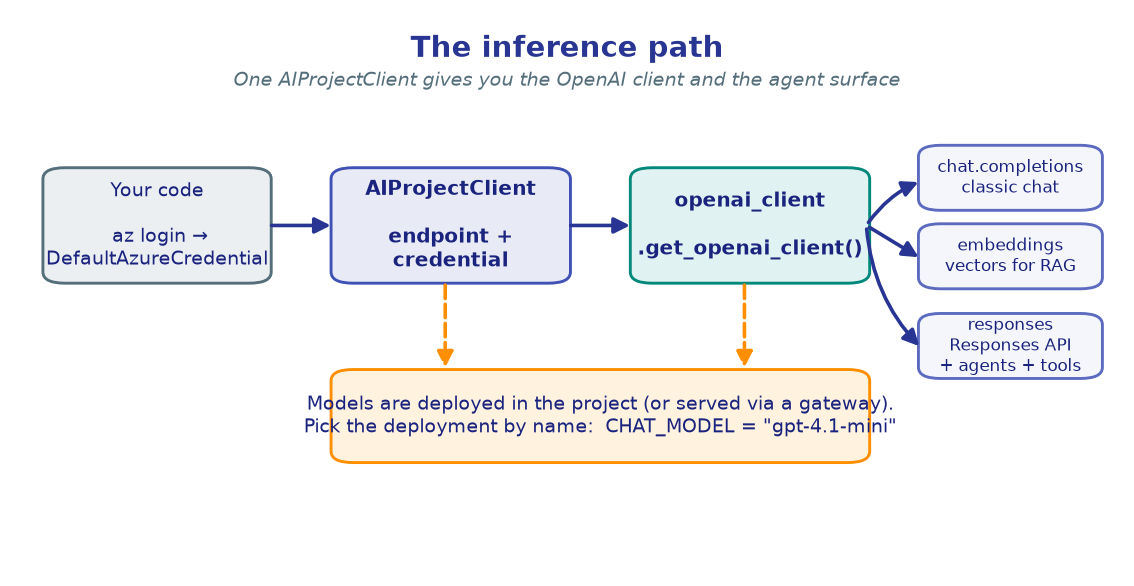
project_client = AIProjectClient(endpoint=PROJECT_ENDPOINT, credential=DefaultAzureCredential())
openai_client  = project_client.get_openai_client()
You build exactly this in M1 · First inference, and reuse it in every lab after.
2. From completions to agents
A raw model call is stateless. A Foundry agent wraps a model with instructions and tools in a versioned definition, and you invoke it through the Responses API. The model can call tools, loop on their results, and return a final answer.
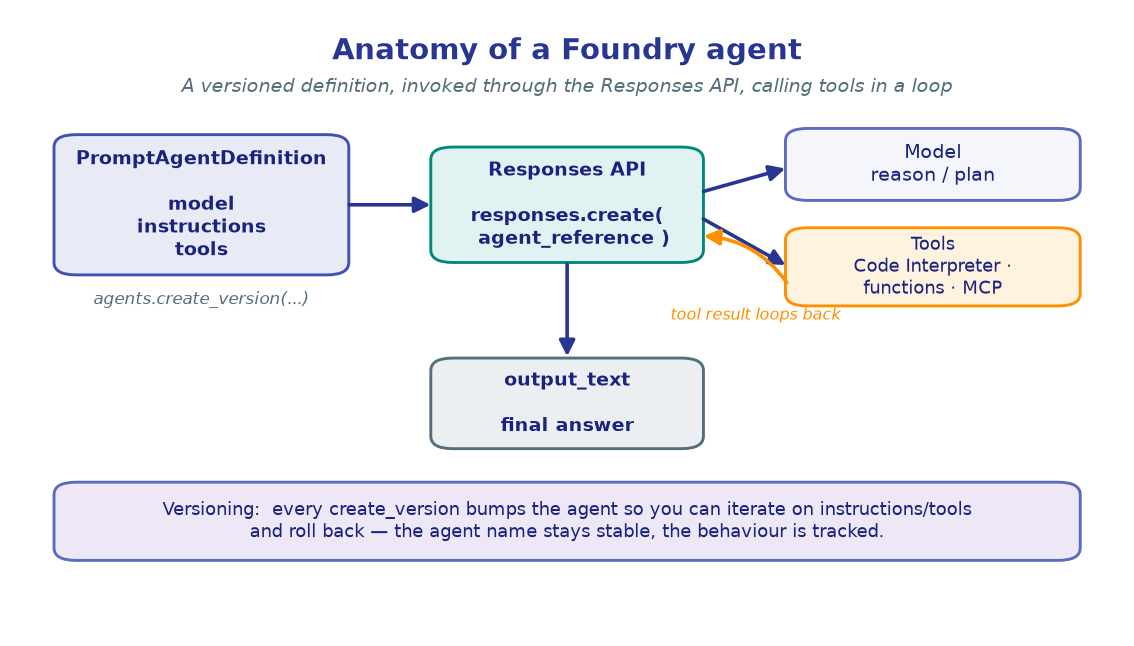
- M2 — create and version an agent.
- M3 — give it tools (Code Interpreter + your own functions).
- M6 — let it remember across turns.
3. Grounding: agents that cite your data
Models hallucinate; grounding fixes answers to your corpus. You embed documents, index them in Azure AI Search, build a Foundry IQ knowledge base, and attach it to an agent so every answer is backed by citations.
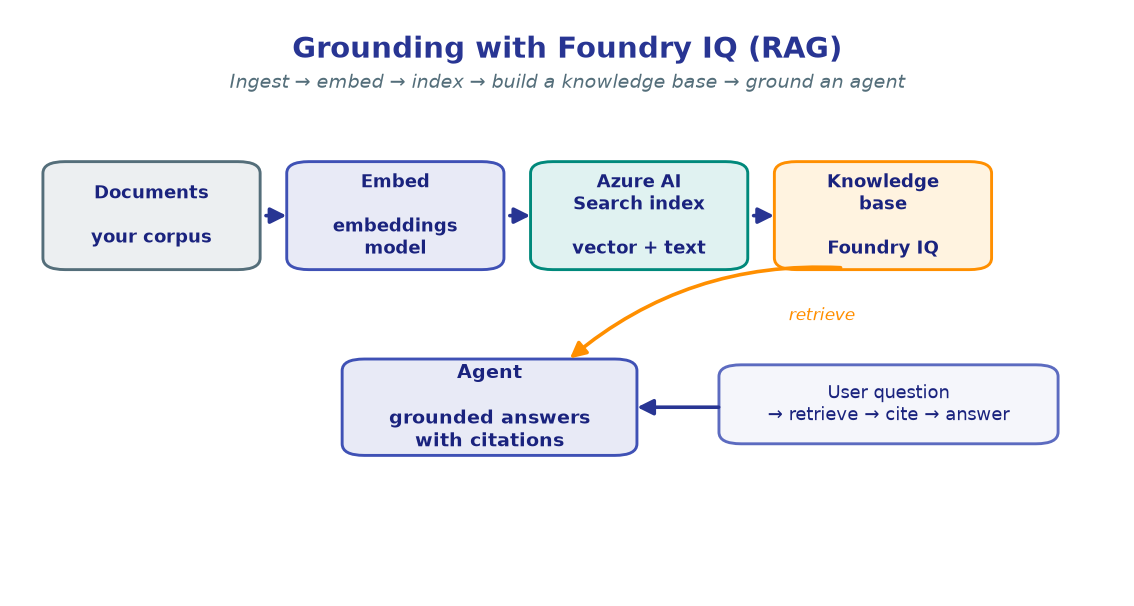
- M4 — single grounded agent.
- M5 — reach external systems through MCP tools.
- M5b — ground in live, permission-aware Work IQ (Microsoft 365) context.
- M8 — multi-step research over the corpus.
4. Scaling out: many agents, one workflow
One agent can't be expert at everything. A router classifies intent and dispatches
to a specialist — each grounded on its own knowledge base — wired together with the
Agent Framework's WorkflowBuilder.
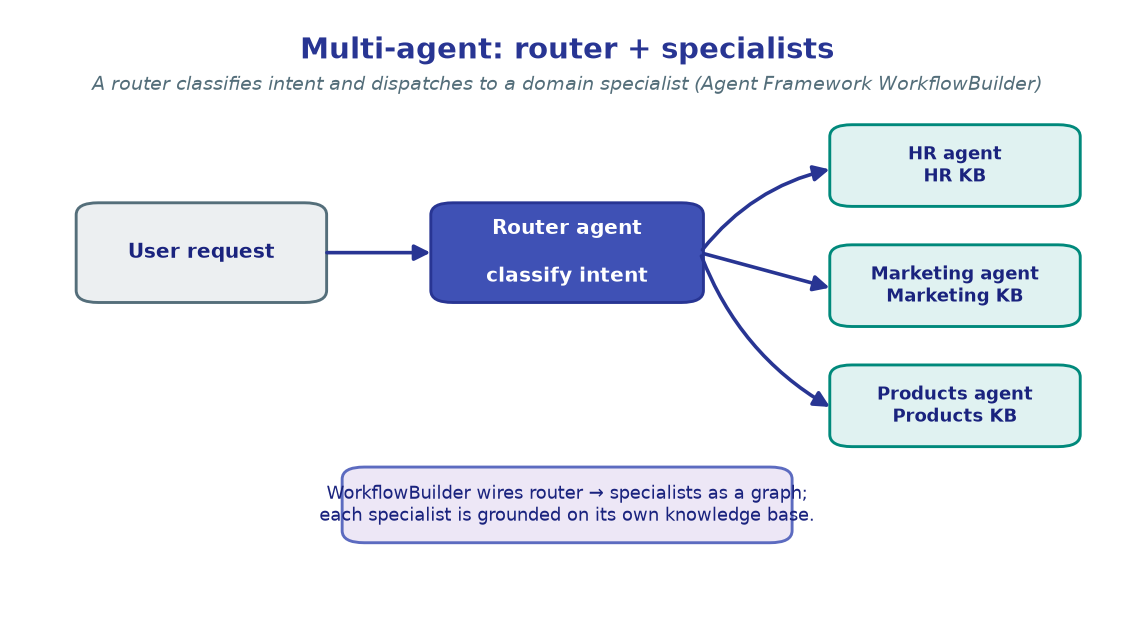
You build this in M7 · Multi-agent orchestration.
5. Trust: measure, watch, and harden
A demo agent and a production agent differ in one word: trust. Foundry bakes in the quality loop — evaluate offline before you ship, observe online after, and feed findings back into the agent.
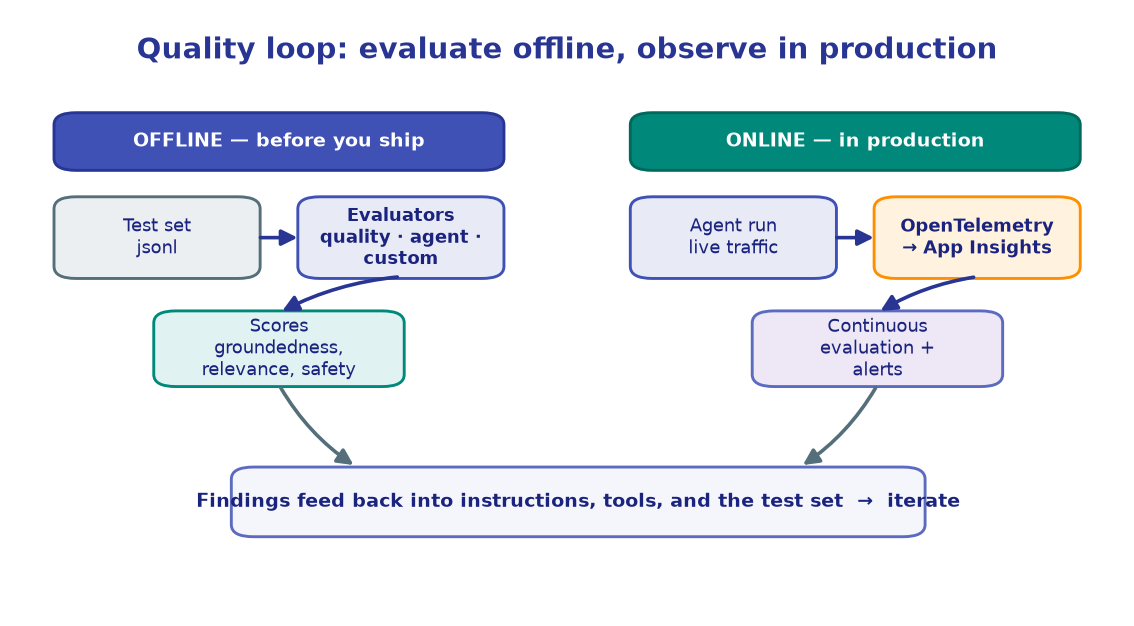
- M9 · Evaluation — score quality before shipping.
- M10 · Observability — trace + evaluate continuously in production.
- M11 · Guardrails & M12 · Red teaming — block unsafe content and probe for weaknesses.
- M13 · Human-in-the-loop & REST — require approval for sensitive actions; invoke over raw REST.
6. Going further: customize the model itself
When prompting isn't enough, fine-tune. In M14 you distill a large teacher model into a small, cheap student with LoRA/PEFT.
How it all fits
                          ┌─────────────── one Foundry project ───────────────┐
  M1 inference  ─►  M2 agent  ─►  M3 tools  ─►  M4 grounding  ─►  M5 MCP / M6 memory
                                                     │
                                                     ▼
                                       M7 multi-agent  ─►  M8 deep research
                                                     │
                          ┌──────────────────────────┴──────────────────────────┐
                       quality & trust:  M9 eval · M10 observability · M11 guardrails
                                          M12 red-team · M13 HITL+REST · M14 fine-tune
                          └──────────────────────────┬──────────────────────────┘
                                                     ▼
                                            M15 capstone (combine it all)
→ Start building: M1 · First inference