M8 · Deep Research
Goal: run an agentic research loop — a reasoning model that plans, searches a knowledge source, iterates, and returns a cited synthesis. You'll use:
o3-deep-researchoverchat.completionswith function tools, plus a chat model for the final report.
A normal chat answer is one shot. Deep research is different: you pose a hard question,
and a reasoning model (o3-deep-research) plans an investigation — it decides what to
search, reads what it fetches, searches again to fill gaps, and only then concludes.
A second, cheaper model turns those findings into a clean, cited report.
The loop you'll build:
question → o3-deep-research ──▶ search(query)   ┐
              ▲                  fetch(doc_id)    │  iterate until the model
              └───── tool results ◀──────────────┘  stops calling tools
                                   │
                                   ▼
                         gpt-4.1-mini synthesises a cited report
!!! note "One project, two model roles"
The reference deploys o3-deep-research in a separate region behind an APIM gateway. In
our single-project setup both deployments live on the same project, so one
get_openai_client() serves both. Deep-research models are preview and can run for
minutes — pin azure-ai-projects / openai in pyproject.toml if a shape drifts.
1. Configure
Two model deployments: the research model that does the planning/tool-calling, and the
synthesis model that writes the report. RESEARCH_MODEL defaults to o3-deep-research.
import os, json, time
from dotenv import load_dotenv

load_dotenv()  # reads .env from the repo root

PROJECT_ENDPOINT = os.environ["PROJECT_ENDPOINT"]
RESEARCH_MODEL   = os.environ.get("RESEARCH_MODEL", "o3-deep-research")
SYNTHESIS_MODEL  = os.environ.get("CHAT_MODEL", "gpt-4.1-mini")
MAX_ITERATIONS   = 6   # safety cap on the research loop

print("Project   :", PROJECT_ENDPOINT)
print("Research  :", RESEARCH_MODEL)
print("Synthesis :", SYNTHESIS_MODEL)
!!! note "Expected output"
Project : https://<account>.services.ai.azure.com/api/projects/<project> Research : o3-deep-research Synthesis : gpt-4.1-mini
Splitting the roles is deliberate: reasoning models are powerful but slow and pricey, so
you let one think and a cheaper one write.
2. Build the client
The familiar bootstrap. Because a deep-research call can run for minutes, we derive a
long-timeout view of the client with .with_options(...) for the research loop, and use the
default client for fast synthesis.
from azure.identity import DefaultAzureCredential
from azure.ai.projects import AIProjectClient

credential     = DefaultAzureCredential()
project_client = AIProjectClient(endpoint=PROJECT_ENDPOINT, credential=credential)
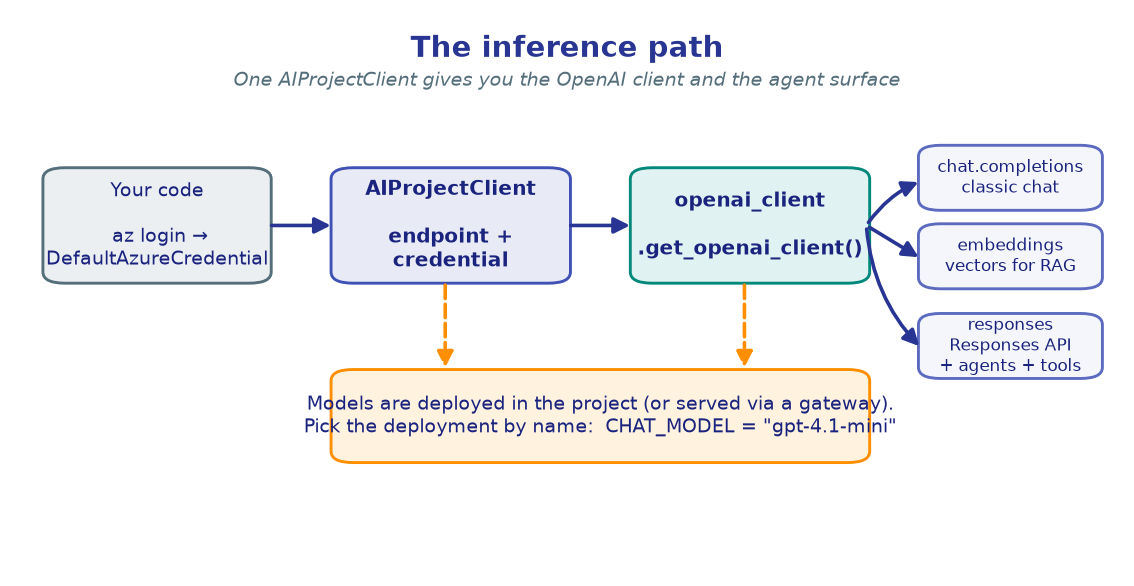
openai_client  = project_client.get_openai_client()

research_client = openai_client.with_options(timeout=600.0)  # o3 can run several minutes

print("openai_client   : ready")
print("research_client : ready (timeout=600s)")
!!! note "Expected output"
openai_client : ready research_client : ready (timeout=600s)
A read-timeout error during research almost always means the default 60s timeout — the
with_options(timeout=600.0) view above is what prevents it.
3. A knowledge source + two tools
The model can't search the open web here — it researches a knowledge source you control.
We use a tiny in-notebook corpus of paper abstracts so the lab is self-contained, and expose
it through two function tools the model will call: search (find relevant docs) and
fetch (read one in full).
# A miniature corpus — in production this is a Foundry IQ knowledge base (see note).
CORPUS = {
    "doc-001": {"title": "Prototypical Networks for Few-Shot Learning",
                "text": "Prototypical networks learn a metric space where classification is "
                        "performed by computing distances to per-class prototypes. Strong on "
                        "miniImageNet 5-way 5-shot; simpler than matching networks."},
    "doc-002": {"title": "Model-Agnostic Meta-Learning (MAML)",
                "text": "MAML learns an initialization that adapts to a new task in a few "
                        "gradient steps. Model-agnostic; competitive few-shot accuracy but "
                        "costly second-order gradients."},
    "doc-003": {"title": "Matching Networks for One Shot Learning",
                "text": "Matching networks use attention over a labelled support set to "
                        "classify with one example per class; introduced episodic training."},
    "doc-004": {"title": "Linformer: Self-Attention with Linear Complexity",
                "text": "Linformer projects keys and values to a low-rank form, reducing "
                        "self-attention from O(n^2) to O(n) in sequence length."},
}

def tool_search(query: str) -> dict:
    """Return doc summaries whose title/text match any query keyword."""
    terms = {w.lower().strip('.,?') for w in query.split() if len(w) > 3}
    hits = [{"id": i, "title": d["title"], "summary": d["text"][:120] + "..."}
            for i, d in CORPUS.items()
            if terms & set((d["title"] + " " + d["text"]).lower().split())]
    print(f"   search({query[:48]!r}) -> {len(hits)} hit(s)")
    return {"results": hits}

def tool_fetch(document_id: str) -> dict:
    """Return the full document by id."""
    print(f"   fetch({document_id!r})")
    doc = CORPUS.get(document_id)
    return doc | {"id": document_id} if doc else {"error": "not found"}

TOOLS = [
    {"type": "function", "function": {
        "name": "search", "description": "Search the research corpus; returns doc ids + summaries.",
        "parameters": {"type": "object",
                       "properties": {"query": {"type": "string"}}, "required": ["query"]}}},
    {"type": "function", "function": {
        "name": "fetch", "description": "Fetch the full text of one document by its id.",
        "parameters": {"type": "object",
                       "properties": {"document_id": {"type": "string"}}, "required": ["document_id"]}}},
]
print(f"Corpus: {len(CORPUS)} docs | tools: search, fetch")
!!! note "Expected output"
Corpus: 4 docs | tools: search, fetch
!!! tip "Swap in a real knowledge base"
In production the search/fetch bodies call a Foundry IQ knowledge base instead of
a dict — the same grounding you built in M4. Read its endpoint from .env
(SEARCH_ENDPOINT) and POST to the KB's retrieve API; provisioning the KB is covered
in the Platform docs. The loop below is unchanged.
4. The deep-research loop
This is the heart of the lab. We hand the research model the question + tool schemas, then loop: each turn the model either calls tools (we execute them and feed results back) or stops — signalling it has enough to conclude. We track iterations and tool calls so the process is observable, and cap the loop for safety.
def run_deep_research(question: str) -> dict:
    """Agentic loop: o3-deep-research plans + calls tools until it's ready to conclude."""
    messages = [
        {"role": "system", "content":
            "You are a deep-research assistant. Investigate the user's question using the "
            "search and fetch tools: search broadly, fetch the most relevant documents, and "
            "search again to fill gaps. Cite document ids like [doc-001]. If the corpus does "
            "not cover the question, say so explicitly rather than guessing."},
        {"role": "user", "content": question},
    ]
    tool_calls_made, iterations = [], 0

    for iterations in range(1, MAX_ITERATIONS + 1):
        print(f"Iteration {iterations}")
        msg = research_client.chat.completions.create(
            model=RESEARCH_MODEL, messages=messages, tools=TOOLS,
        ).choices[0].message
        messages.append(msg)

        if not msg.tool_calls:
            break  # model is done researching

        for call in msg.tool_calls:
            args = json.loads(call.function.arguments)
            result = tool_search(**args) if call.function.name == "search" else tool_fetch(**args)
            tool_calls_made.append(call.function.name)
            messages.append({"role": "tool", "tool_call_id": call.id,
                             "content": json.dumps(result)})

    findings = msg.content or "(model concluded without a summary message)"
    return {"findings": findings, "iterations": iterations,
            "tool_calls": tool_calls_made, "messages": messages}

print("run_deep_research() ready")
!!! note "Expected output"
run_deep_research() ready
The loop ends when the model returns a message with no tool_calls — that's o3
signalling "I've gathered enough." The MAX_ITERATIONS cap is your guardrail against a
model that keeps searching forever.
5. Run a question → synthesise a cited report
Pose a real question, run the loop, then hand the model's findings to the synthesis model to format a clean report. Splitting research from writing keeps the expensive reasoning focused and lets a fast model do the prose.
question = ("What are the main approaches to few-shot learning in the corpus, "
            "and how do they differ? Cite the documents.")

research = run_deep_research(question)

report = openai_client.chat.completions.create(
    model=SYNTHESIS_MODEL,
    messages=[
        {"role": "system", "content": "You are a research report writer. Turn the findings "
         "into a concise, well-structured report. Preserve every [doc-id] citation."},
        {"role": "user", "content": f"Question:\n{question}\n\nFindings:\n{research['findings']}"},
    ],
).choices[0].message.content

print(f"\nIterations : {research['iterations']}")
print(f"Tool calls : {research['tool_calls']}\n")
print(report)
!!! note "Expected output" ``` Iteration 1 search('few-shot learning approaches') -> 3 hit(s) Iteration 2 fetch('doc-001') fetch('doc-002') fetch('doc-003') Iteration 3
Iterations : 3
Tool calls : ['search', 'fetch', 'fetch', 'fetch']

## Few-Shot Learning Approaches in the Corpus

The corpus describes three distinct families:

- **Metric-based** — Prototypical Networks classify by distance to per-class
  prototypes [doc-001], while Matching Networks use attention over a support set
  and introduced episodic training [doc-003].
- **Optimization-based** — MAML learns an initialization that adapts in a few
  gradient steps, at the cost of second-order gradients [doc-002].

Metric methods are simpler and cheaper; MAML is model-agnostic but costlier...
```
Notice the **shape**: search → fetch the promising hits → conclude → cited report. The
model planned the investigation; you only supplied the tools.
6. Respect the knowledge boundary
A trustworthy researcher admits what it doesn't know. Ask something the corpus can't cover and watch the model decline rather than hallucinate — the system prompt told it to say so explicitly when the corpus falls short.
oos = run_deep_research("What are the latest breakthroughs in nuclear fusion energy?")

print(f"\nIterations : {oos['iterations']}")
print(f"Tool calls : {oos['tool_calls']}\n")
print(oos["findings"])
!!! note "Expected output" ``` Iteration 1 search('nuclear fusion energy breakthroughs') -> 0 hit(s) Iteration 2
Iterations : 2
Tool calls : ['search']

The corpus does not contain any documents on nuclear fusion energy — it covers
few-shot learning and transformer efficiency in NLP. I can't answer this from the
available knowledge source.
```
!!! tip "Grounding beats guessing"
The empty search result is the signal: with nothing to fetch, a well-prompted research
model reports the boundary instead of inventing citations. This honesty is exactly
what you'll measure in M9 · Evaluation.
🧪 Your turn
- Add a document. Drop a new
doc-005about cross-lingual transfer intoCORPUS, then ask a multilingual-NLP question — confirm the loop searches, fetches it, and cites it. - Watch it iterate. Ask a comparison that spans two topics ("Contrast few-shot metric
methods with efficient attention") and print
research['tool_calls']— you should see multiple search/fetch rounds. - Tune the cap. Lower
MAX_ITERATIONSto1and observe the loop stop early with a thinner report; raise it and watch the model dig deeper. This is the cost/quality dial.
✅ You ran an agentic deep-research loop — plan, search, fetch, iterate — and turned its findings into a cited report, with the model honouring its knowledge boundary. Next: measure answer quality, groundedness, and safety systematically. → M9 · Evaluation